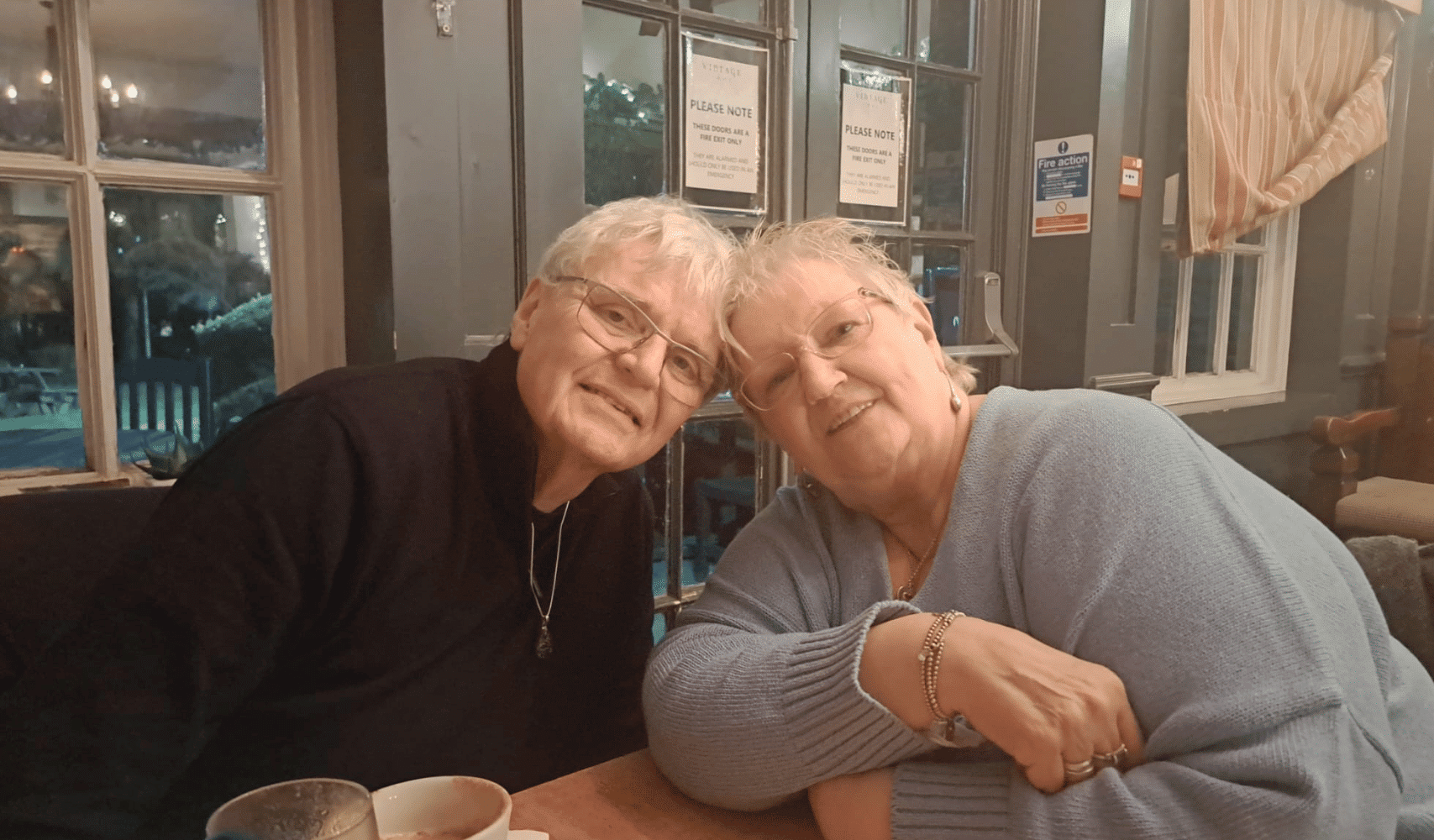
While living with stage four liver disease, Roly, from London Colney, has made use of a number of the services offered by Rennie Grove Peace Hospice Care. Here he explains how he came to use the services and the different ways they have supported him to live well with his illness.
Support at home after hospital
Roly explains:
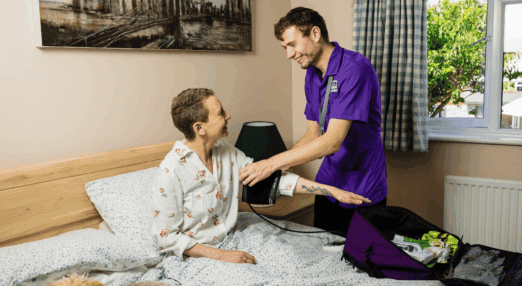
“My first experience of Rennie Grove Peace was when I was discharged from hospital [in January 2024] after a five month stay and referred to Rennie Grove Peace for Hospice at Home care.”
Roly’s wife, Caroline, recalls:
“Roly’s time in hospital was very difficult for both of us. To have the Rennie Grove Peace nurses supporting him once he came home made a huge difference. He was still experiencing a lot of pain and they were just wonderful at getting that under control. They became like part of the family. We could talk to them about anything and bring any of our worries or concerns to them. If Roly had a concern about this illness, they would do whatever they needed to, to help him. Even if that meant contacting other services or getting in touch with people on his behalf.
“I have my own health challenges so without this support I don’t think I would have been able to cope on my own. If we hadn’t had the Hospice at Home team to turn to, I would have ended up dialling 999 when I had concerns. And that wasn’t what either Roly or I wanted, especially after such a long stay in hospital.”
Transition after Hospice at Home
Once Roly’s health stabilised, he was discharged from the Hospice at Home service [in October 2024], with the reassurance that the support would be available again, if and when he needed it.
Planning ahead for future care
The following year Roly attended the Specialist Nurse Clinic at Grove House, where he was offered a place on the charity’s Advance Care Planning course – to think about his care wishes and make plans for the future. Roly says:
“I’m a very pragmatic person. So, knowing that my liver disease is stage 4, it made sense for me to attend the Advance Care Planning course and think about my options for future care.
“The course was helpful at guiding me through what I needed to consider and making decisions. It has helped me to set out where I’d like to be cared for at the end of my life and I’ve gone on to make practical arrangements like plans for my funeral.
“It is reassuring to know that this is all in hand and will be one less thing for my family to think about.”
Opening up conversations
Although Caroline chose not to attend the Advance Care Planning course with Roly, the couple both agree that the process has prompted them to have open conversations at home.
Caroline says:
“We’ve always been very open and honest with each other but of course this is a difficult subject for anybody to discuss with their loved ones. Roly completing the Advance Care Planning course has really encouraged us both to open up and discuss these topics at length. We both now know exactly how the other feels. That has really helped us to feel strong and united as a couple.
“It’s not an easy conversation. But we’ve come to realise that it’s OK to cry and be upset. We have come to terms with the fact that the situation isn’t ideal. But we can talk openly and honestly about our feelings and that helps.”
Emotional support through counselling
One thing that has helped both Roly and Caroline to process their feelings about Roly’s illness has been counselling, provided by Rennie Grove Peace. Roly has accessed one-to-one counselling twice and Caroline has completed six sessions with a counsellor to help her make sense of her feelings and understand the emotions she has experienced during Roly’s illness.
“The counsellor was excellent. She helped me to understand more about preparatory or anticipatory grief and that made a lot of things make sense. The sessions helped me realise that my response was normal and that I wasn’t alone.”
Living Well programme
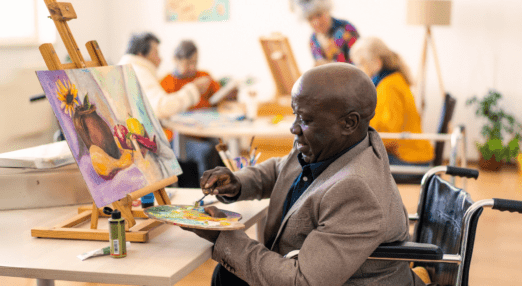
One of the nurses running the Advance Care Planning course that Roly attended, suggested that he might benefit from completing the Living Well course. So he joined the 8-week course, starting in January 2026.
He says:
“The Living Well programme was great. I would describe it as a very empowering experience. The staff were wonderful. The course was really informative and I learned a lot about myself while I was there. It really helped me to establish the best ways to go forward, for as long as I can.
“I found it really helpful to meet the other people on the course
We all have our own health challenges so you’re surrounded by a group of people who understand. I found this really helpful for having honest conversations – because I was with people who understand, but aren’t as close to me as my family, so there was no worry about them being upset by anything I had to say.
“I was sad when the course came to an end as it was such an empowering and positive experience for me. I feel more settled since doing it. And it has certainly helped me to open up with Caz.”
What hospice care really means
SPOKESPERSON at Rennie Grove Peace, says:
“Many people think of hospice care as being limited to the last days or weeks of a person’s life. But at Rennie Grove Peace we offer support to people living with progressive life-limiting illnesses right from the point of diagnosis, in four main phases: early support, living well, end of life care and bereavement support.
“As Roly’s story shows, there’s no ‘one size fits all’ approach to the care we offer. Many people believe that our Hospice at Home service is only for people in the end of life phase but as we see in Roly’s case, it was the perfect service to stabilise him after a hospital stay, before he was well enough to be discharged from that service and access living well support as an outpatient.
“The emotional support that he and his wife, Caroline, have received demonstrates that our services are here to look after those around each patient as well. Our emotional support is testament to the fact that palliative care is about the whole person, not just their physical symptoms.”
How we can help you
-

Living Well activities
Come along to our free groups and activities designed to give you confidence - whether you're a patient, carer, or family member - to live well, feel supported, and boost your wellbeing.
Read more
-
Care at home
We bring your care into your home, day and night, so you can be surrounded by people and things you love the most.
Read more
-
Advance Care Planning course
Helping you plan for the future with our free Advance Care Planning course
Read more